

Authored by Gavin Dunnaway, Senior Product Marketing Manager
I didn’t really understand agentic transactions in digital advertising until I thought about a bunch of robots chatting in a bar.
Stick with me—I swear it’s not as crazy as it sounds.
Happy Hour? Nah, Call It ‘Relationship Building’
Anyone who has worked in advertising (or watched a few seasons of Mad Men) knows the legends of advertising deals negotiated over three-martini lunches. Digital advertising also has a history of contracts signed on a dirty bar in the wee hours of the morning.
In the age of digital signatures, these may sound like fables, but we all know quality relationships are key to driving business in advertising… And for better and worse, many of these relationships are forged over copious consumption—particularly on Le Croisette in Cannes.
At the dawn of programmatic advertising, the question was often raised: won’t this automation kill the need for human relationships—particularly ones that drive up $5K bar tabs? Doesn’t that seem quaint in retrospect? The same question is being asked as agents slip into advertising workflows—arguably human networking is needed even more now with vast confusion over the roles and functions of AI? Relationships are key for cutting through hype, and understanding who actually has agents, workflows, and orchestration that will solve specific bottlenecks.
But kinda crazier, agent relationships with other agents will become increasingly important—and where else they supposed to meet but the AI bar?
Where Everybody Knows Your Agent’s Name
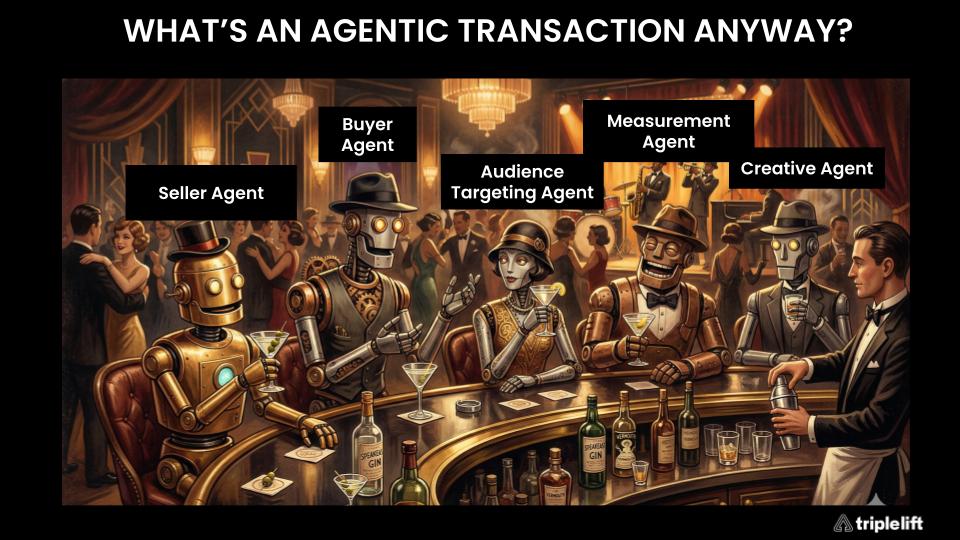
So imagine: a city with Jazz Age Steampunk vibes (a hopping new genre, I tell ya), where the Model Context Protocol (MCP) is a trolley that delivers various ad agents—buyer, seller, audience, measurement, etc.—to nightclubs like AdCP or Agentic Direct, the latter run by the IAB Tech Lab family. Yes, in my vision, ad-focused agentic protocols are bars built off MCP trolley stops. They’re also a little seedy because I watched too many noir movies growing up.
An advertiser sends its buyer agent off to THE AD PROTOCOL—a cozy little watering hole featuring up-and-coming blip-bop acts—with a natural language brief: client has a $2M budget for pushing widgets to working mothers in their 30s in the Midwest. It’s looking to increase sales by 20% via a big box retailer.
That agent works its way over to the bar, orders a binary martini (shaken, not compiled) and strikes up a conversation with a local seller agent about what kind of inventory availability might fit the campaign’s needs. An audience agent happens to be freshening up their Old Turing (you’d be convinced it’s actually gin, vermouth, and bitters), and comments, “Oh, I’ve got a ton of deterministic segments that fit that bill, plus some red-hot intent signals.”
They elbow a Measurement Agent, who’s nursing an Attribution Sidecar; that agent perks up and says, “Oh, I’ve got an outcomes vendor who’d be perfect for proving impact.” All the while, the Creative Agent is lurking in the corner, taking swigs off their CTR (a popular cheap digital beer among hipster agents that tends to disappoint and cause headaches), and dreaming up high-impact formats they could build with existing advertiser assets.
After another few rounds, the deal comes together, and the agents assemble a deal proposal that the Buyer Agent can take back to its human operator for approval, and then activate in a DSP.
What’s a Little Streamlining Among Friends
I told you it’s a weird analogy, but it helps visualize how agents could take over very manual processes that tend to be smothered in email exchanges and conference calls. And agentic here is not about replacing anyone who performs the above functions—often it’s teams assembling each component of these deals.
Those teams are still very necessary—but how their good work is activated becomes far easier. We need to think of agents as tools for streamlining workflows and sharing information to improve speed to market and efficiency. And when those are accomplished, we can scale, focus on actual metrics that drive performance, creative and messaging that actually spark consumer action, and other meaningful stuff beyond the pipes we’ve been obsessed with in my 17 years in digital advertising.
OK, there is one more pipe optimization. I can’t describe my robot bar fantasy without thinking, “You know, this still seems kinda complicated.” Does the Buyer Agent really need to be chatting up all those different agents?
No — and that’s where the Sell-Side Orchestrator comes in. Rather than head directly to the bar to corral disparate agents, the Buyer Agent rolls up to the Orchestrator’s table—with a great view of tonight’s band, The QPS Express, but not too loud for conversation—and delivers their brief. The Orchestrator has Supply, Creative, Audience, and Measurement agents chilling out on their shoulders—they listen in and quickly coordinate a unified proposal to bring back to its advertiser.
With that out of the way, the Buyer Agent and Orchestrator clink their Analog Fashioneds and enjoy a killer rendition of “It Don’t Mean a Hoot, If You Ain’t Got Compute.”
Will SSPs Eat Us All?
Now I know what you’re thinking: “Dude from an SSP is saying SSPs are going to take over the middle—supa cringe!” No! It’s an extension of what I was saying earlier—SSPs can streamline a lot of functions within supply curation to enable other parties to focus on what they do best.
Sell-Side Orchestration doesn’t replace agencies—it empowers them to focus on not just overarching campaign strategies, but also quickly executing opportunistic campaigns across channels through their preferred DSPs. And DSPs can curate supply with publisher behavioral and contextual signals while bringing in their own audience signals and AI performance agents.
Agents are not replacing anybody in digital advertising, but in optimizing workflows and building efficiencies, they are shifting us around a good deal and reimagining partnerships. In fact, at our TripleLift NYC Impact Forum, I was moderating a panel of agencies and platforms who told me just that: the greatest change they’d noticed from AI was the way they worked with their partners… almost always for the better.
Which is why just as the agents are getting together at their favorite ad-based MCP watering hole, you should be catching up with the latest from your partners IRL about their agentic efforts. You’ll probably be surprised at what you can do together and how both organizations may benefit.
You can even hook up at the place down the street with the killer wing special during happy hour. Who is putting down the plastic?